


The construction of a concrete wall requires the use of formwork panels and stop-end formwork, depending on the wall length or the site configuration.
The concrete pour stop makes it possible to define this area precisely. On a wall built using concrete wall formwork, it must retain the fresh concrete until it has set while allowing the future construction joint to be properly prepared.
This common operation in the structural construction sector can nevertheless be restrictive when it requires the handling and adjustment of rigid devices. The use of Pronal inflatable concrete wall formwork offers a different approach by replacing the traditional stop-end element with a flexible, lightweight solution that is quick to install.
Why is a concrete pour stop an important step on a construction site ?
A concrete pour stop does not simply consist of stopping the pour. It creates a temporary separation between two construction phases of the same structure.
In the case of a concrete wall built using concrete wall formwork, the stop-end is placed between the two sides of the concrete wall formwork, at the exact point where the concrete needs to stop. It must withstand the pressure of the fresh concrete and provide a suitable area for the continuation of the work.
Traditional systems may require the preparation of rigid components, as well as various positioning, securing, and dismantling operations. These operations take time and involve additional manual handling, potentially leading to musculoskeletal disorders (MSDs) in the long term.
The quality of this stage is also important for the rest of the project. A properly executed stop area facilitates the continuation of concreting and helps control possible cement laitance leakage during pouring.
The objective is therefore twofold : to effectively contain the concrete while reducing installation constraints for formwork workers.
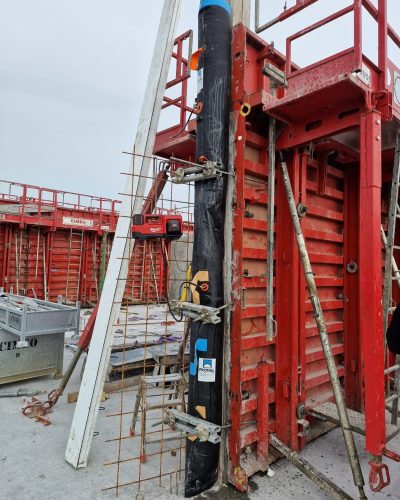
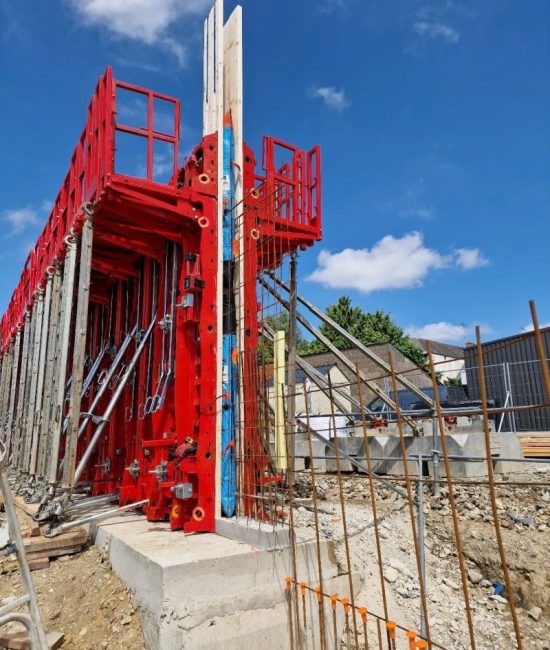
How does an inflatable solution simplify concrete pour stops ?
The principle of the Pronal inflatable concrete wall formwork is based on a different installation method compared to traditional rigid systems.
The product is first inserted between the formwork panels, either deflated or partially inflated, depending on the site configuration. Its small size when deflated makes it easier to position at the exact point where the pour stop must be created. Once in place, it is inflated at low pressure so that it expands and forms the temporary end of the wall.
The concrete can then be poured against the stop-end.
After the concrete has set, the device is deflated. As it loses its volume, it separates more easily from the concreted area and can be removed without requiring the dismantling of a rigid structure.
This technology therefore does not replace the concrete wall formwork used to form the wall. It is installed specifically at its end to create the concrete pour stop.
For structural construction teams, the main advantage lies in the simplicity of the operating cycle. The same principle is used successively for positioning, concreting and removing the device, without multiplying the number of components that need to be assembled on site.
It also maintains the essential function of the concrete wall stop-end while offering a solution that is lighter to handle.
What are the advantages of the Pronal inflatable concrete wall formwork ?
Pronal has developed an inflatable concrete wall formwork designed for concrete pour stop operations. The device operates at an inflation pressure of 1 bar, and its standard height of 1.60 m can be adapted according to the requirements of the construction site.
Its flexible design first addresses a handling issue. Unlike a stop-end system made up of rigid elements, the product can be transported and installed without requiring heavy equipment solely for handling it.
Speed is also one of its main advantages. Pronal indicates an installation time of approximately one minute and removal in less than five minutes. Deflation particularly facilitates the removal of the stop-end once the concrete has sufficiently set.
This approach also offers benefits in terms of working conditions during formwork operations. The use of an inflatable stop-end helps reduce certain handling operations and awkward working postures associated with traditional systems.
Finally, the device helps limit cement laitance leakage and control the area intended for the continuation of concreting.
The use of an inflatable stop-end is particularly relevant when teams regularly construct concrete walls using concrete wall formwork and are looking to reduce the time spent on intermediate operations between two pouring phases.
By transforming a traditionally rigid element into a lightweight pneumatic solution, Pronal provides a simple response to an everyday issue faced by structural construction teams. The objective is not to change the way the wall itself is built, but to make the concrete pour stop quicker to install, easier to handle and easier to remove.
Do you have a project, a specific constraint or a particular requirement ? Our teams are available to assess your needs and provide a solution tailored to your operational requirements.
Contact us to continue the discussion and work together to develop high-performance, sustainable solutions.